


Why Are Chicken Eggs Different Colors?
If you’ve ever stared down a carton of eggs and wondered why some look like minimalist art and others resemble a Pinterest project gone right, you’re not alone. The rainbow of chicken eggs—white, brown, blue, green, even speckled—isn’t some poultry-powered Easter miracle. It’s pure genetics, baby.
Each breed of chicken comes with its own egg-laying software preinstalled. You can’t change the settings with mood lighting or motivational clucking.
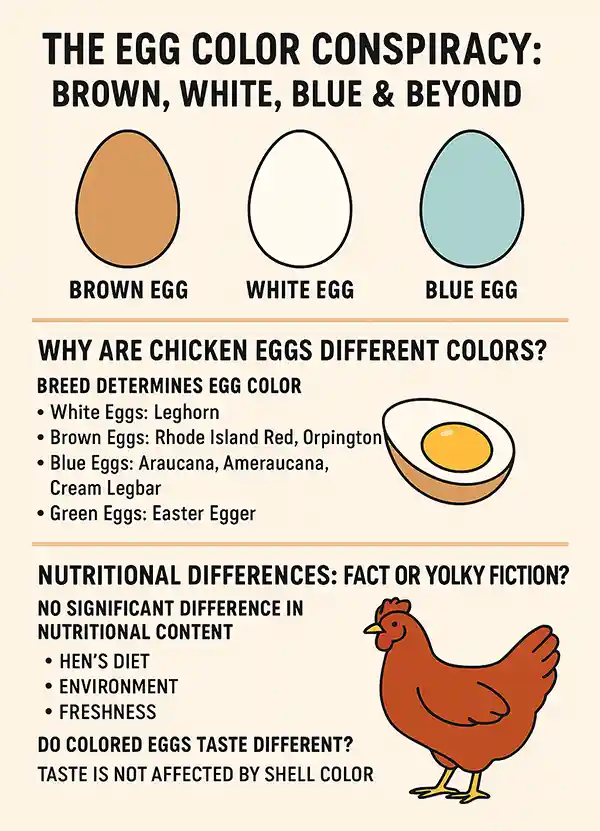
- White Eggs come from your no-nonsense types—like the Leghorn, a svelte, high-production hen who lays eggs like it’s trying to win a race. These birds usually have white feathers and white earlobes, and zero interest in boutique nesting boxes.
- Brown Eggs are the standard-issue favorite of backyard chicken keepers and organic markets. Breeds like the Rhode Island Red and Orpington lay these. Brown-feathered hens with red earlobes are the culprits, and yes—they eat a bit more feed. That extra expense? You’re paying for the poultry equivalent of premium unleaded.
- Blue Eggs? Now we’re in hipster territory. Laid by the Araucana, Ameraucana, and Cream Legbar, these pastel beauties look like they were laid during a watercolor workshop. It’s all thanks to a gene called oocyan, which turns the entire shell blue—inside and out.
- Green Eggs come courtesy of the Easter Egger, a delightful mutt of a chicken with a grab-bag of genetics. You never quite know what you're going to get—blue, green, olive, even pinkish if the stars align and your chicken reads poetry.
- Speckled Eggs show up like little surprises from breeds like Marans or Welsummers. The speckles? They're just extra calcium deposits. Think of them as freckles—not a flaw, just a feature.
So, no—there’s no mystical diet of blueberries or mud pies making those shells. It’s all about the hen’s breed and biology, with a dash of “because nature said so.” Next time someone tells you brown eggs are “more natural,” you have my permission to roll your eyes—politely, of course.
Nutritional Differences: Fact or Yolky Fiction?
Ah, yes, the age-old question whispered in produce aisles and backyard coops alike, “Are brown eggs healthier than white ones?” Spoiler alert: That’s a no, scrambled in marketing and lightly seasoned with urban legend.
Here’s the truth: Eggshell color has exactly zero impact on nutritional content. That brown shell? Just a different paint job. That blue shell? Still an egg. Whether you’re cracking into a store-brand white or an Instagram-ready robin’s-egg blue, what’s inside is largely the same:
- Protein powerhouse (about 6 grams)
- A multitasking yolk loaded with vitamins B12, D, and choline
- Just enough healthy fat to keep things smooth without tipping into bacon-grease territory
But here’s where things actually can vary, and it’s not about shell color—it’s about how the hen lives her life.
Hen’s Diet
Chickens that dine like health-conscious influencers (think flaxseed, greens, and grains) tend to lay eggs richer in omega-3 fatty acids and certain vitamins. Meanwhile, hens on a processed feed diet lay eggs that are… still good, but less Instagrammable on a nutrition chart.
Hen’s Environment
Sunshine and exercise aren’t just for retirees in Florida—chickens benefit too. Hens allowed to forage and bask in natural sunlight produce eggs with more vitamin D, thanks to all that good ol’ fashioned UV exposure. That’s right—free-range doesn’t just feel better for the hen, it tastes better for your body.
Freshness Matters
Here’s a yolky twist: eggs start to degrade the minute they’re laid. Over time, the whites get thinner and the yolk flattens. While store eggs can sit for weeks before hitting your fridge, backyard eggs often go from nest box to nonstick skillet in under 24 hours. That difference in freshness is what many mistake as a “taste difference”—it’s not shell color doing the heavy lifting, it’s just good timing.
Flavor Folklore
Some folks swear blind they can “taste the difference” between shell colors. Well, blindfold them and mix up the eggs—they won’t pass the taste test. Any flavor edge usually comes from diet and freshness, not whether the egg was wrapped in brown, white, or teal.
So the next time someone says, “I only eat brown eggs because they’re healthier,” feel free to lean in and whisper, “That’s yolk-lore, not science.” Then make yourself a three-egg omelet—with one of each color—for the sheer thrill of it.
- The hen’s diet: Chickens fed omega-3-rich diets lay eggs higher in omega-3s.
- Environment: Free-range birds that get more sunlight produce eggs with slightly higher vitamin D.
- Freshness: Farm-fresh eggs often taste better simply because they haven’t been lounging around like a teenager on summer break.
So, a brown egg from a backyard Buff Orpington and a white egg from a store-brand Leghorn? Same inside—unless that Buff's been on a kale kick.
Do Colored Eggs Taste Different?
Some people swear blue eggs taste “creamier,” or brown eggs are “richer.” But unless you're conducting a blind taste test with a sommelier of scrambled eggs, it's mostly perception.
However, fresher eggs (often the more colorful, backyard variety) do tend to taste better because the whites are firmer and the yolks sit up higher and brighter. That’s not the shell’s doing—it’s just less time in storage limbo.
Fun Egg Facts You Didn’t Ask For (But Should Brag About Anyway)
- Shell thickness is about the chicken’s age, not the shell’s color. Young hens = thicker shells. Old hens = fragile like your uncle’s ego.
- Brown eggs cost more not because they’re better—but because brown-egg-laying breeds are bigger and eat more. You’re paying for the buffet.
- A chicken's earlobe color predicts egg color. Don’t ask me how evolution landed on that party trick.
Eat what you like and can afford. If the egg is fresh, laid by a healthy chicken, and cooked with love (and maybe a little butter), you’re golden—no matter the shell color.
- Want something Instagram-worthy? Go for blue or speckled.
- Want value? Store-brand whites will do just fine.
- Want smug bragging rights? Raise your own Easter Eggers and name them after characters from Downton Abbey.
Eggshell color is like a fancy paint job on a reliable truck—it looks cool, but the engine’s the same. Brown, white, blue, or green—crack it open, fry it up, and enjoy the miracle that is the chicken egg. You’ve got nothing to fear but shell itself.
Now go forth and poach in peace, my friend.
